
Trace Former Livingston Owners From the Latest Deed
A former-owner search in Livingston County works backward, one deed at a time. Start with the current parcel and its newest ownership deed. The grantor on that deed becomes the next owner of record to trace, and each earlier transfer you find hands you the next name to pull.
| Transfer date | Grantor to grantee | Deed type | Citation to save |
|---|---|---|---|
| Newest verified transfer | Seller to current grantee | As indexed | Document number and book/page |
| Prior acquisition | Earlier seller to that grantor | As recorded | Date and legal description |
| Earlier link | Repeat with prior grantor | Deed, executor, trustee, or other | Map, lot, acreage, reservations |
Every row in your chain must describe the same land. A shared surname means little without a matching legal description, so compare parcel details before you count a transfer as part of the Livingston County chain.
Search Each Livingston Owner as Grantee and Grantor
Work each owner from both ends. Find the deed where that owner took the property as grantee. Then find the deed where the same owner conveyed it as grantor. Search full names, surname-first forms, initials, spouses, entity variants, trusts, and estates. Use date windows and document categories to cut noise. Cloud Search treats index-word behavior differently from OCR or full-text phrase searching. It supplies no assumed wildcard. So old scans and spelling shifts may call for shorter terms. Note which search mode produced each result.
Use Livingston Legal Descriptions to Reject False Matches
Legal descriptions do the real work of rejecting false matches in Livingston County deed records. Compare town, village, road, acreage, lot or filed map, metes-and-bounds calls, adjoining owners, and prior deed citations. An old deed may list no modern address at all. A farm, creek, mill, bridge, or neighboring landowner can be the best continuity clue. A subdivision or lot split can change the SBL. A parent-deed reference often survives in that case. Follow both the recorded plat map and the conveyance. GIS helps with orientation but never replaces the legal description on the deed itself.
Build a Livingston Chain Worksheet
For each transfer, record both dates. Save the execution date and the recording date, plus grantor, grantee, deed type, document number, book and page, consideration if shown, legal description, prior deed reference, and any open questions. Also distinguish mortgages and easements from true deeds, even when one of those instruments is the newest item on the parcel.
- Reverse index
- A party index used to locate conveyances by grantor.
- Chain of title
- The linked record of transfers affecting the same land.
- Quitclaim deed
- A conveyance of whatever interest the grantor has, without the page itself proving the quality of title.
- Warranty deed
- A deed form containing stated covenants, still requiring full record review.
How Far Livingston Ownership Records Go
Livingston County land-record custody runs from 1821 forward, according to the Clerk. The earliest year in the online index is not stated. The same is true of the image collection. So avoid assuming every county deed can be searched or viewed online.
The Historian notes that FamilySearch holds Livingston County land images up to about 1906. That range does not define what the Clerk portal itself covers.
Online cutoff unknown. Use the latest citation, test Cloud Search, then ask the Clerk for older books, microfilm, or copies when former owners disappear online.
The Historian notes that FamilySearch holds Livingston County land images up to about 1906. That range does not define what the Clerk portal itself covers.
Use the Livingston Deed Index for Each Prior Transfer
The Livingston Public Records Cloud Search is where each prior transfer gets pinned down. Its term, date, scope, and document controls help you locate every earlier deed in the chain.
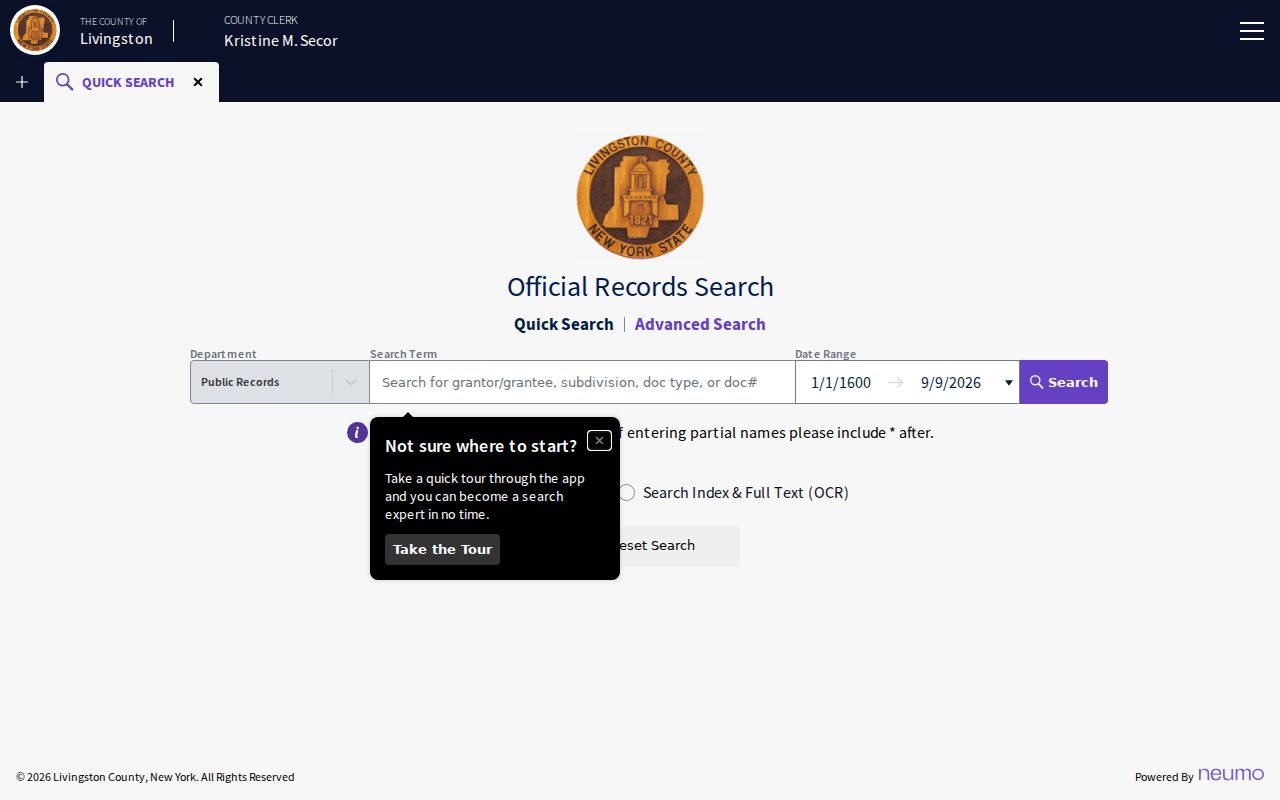
Repeat the search with each earlier grantor in turn. Accept a link only when the legal description and recorded citation both match the same land in the Livingston County property records.
Before 1821, Follow Livingston Parent Counties
Livingston County was formed from Ontario and Genesee Counties in 1821. For older deeds, the parent county depends on the town and the date. Ossian needs special care. County guidance says Ossian was annexed from Allegany County in 1857. An early Ossian chain of title can break. That happens if you search only Livingston County deed records.
County-formation histories, early maps, tax lists, and probate files help you pick the right parent jurisdiction. Then you can return to the later Livingston chain. No courthouse-fire story supports assuming the parcel records were destroyed.
Probate and Executor Deeds in Former-Owner Research
A death can interrupt a clean grantor-grantee pattern in the deed records. Search WebSurrogate by decedent and date. Review the estate file history where public, and watch the Clerk index for executor, administrator, trustee, or beneficiary instruments. The estate record explains who had authority. The recorded deed documents the actual conveyance.
The Historian's cemetery project, obituary files, and newspapers help separate people who share a name. A grave record or obituary is identity evidence, not proof of title.
Historic Maps and Papers Reveal Earlier Livingston Owners
Maps from 1809, 1812, 1823, 1852, 1858, 1872, and 1902 can tie a parcel to a farm, mill, bridge, road, or business. Sanborn and USGS sheets help too. Newspaper legal notices can surface estate sales, tax sales, foreclosures, subdivisions, and renamed firms.
The Historian's digitization program opened more than 4,000 scans in April 2026. Its catalog approaches 50,000 items. More than 291,000 newspaper pages were rescanned. Use these collections to generate names and dates for a property search. Then confirm each one against recorded instruments in the Livingston County property records.
Livingston County Seat Names as Search Clues
Geneseo won the county seat in 1821, beating out Avon, Williamsburgh, and Lakeville. Older notices sometimes carry those rival names instead. A Livingston County deed from that era may reference a place that no longer matches modern maps. Search newspapers and historical maps under each old label, but keep the deed's legal description as your anchor. That description stays stable even when place names shift.
Place names changed too. Avon was once Hartford. Landmarks like Five Arch Bridge, the Opera Block, local springs, or an old mill can open a record trail in Livingston County property records. Treat them as context, though. None of them identifies a parcel on its own.
Know the Limits of a Former-Owner List
Any former-owner list is only as strong as its deeds. The identity work behind them matters just as much. Gaps happen. Name changes, probate, boundary shifts, partial conveyances, and missing deed images all leave holes in the chain of title. Parent-county jurisdiction leaves holes too. Note the uncertainty plainly rather than guessing at an owner of record.
Title caution. Tracing previous owners is historical research, not a certified title opinion; verify the chain and open encumbrances with qualified help when stakes are legal.
Handle Partial Livingston Conveyances and Name Changes
Chains of title in Livingston County rarely break all at once. They fray. An owner conveys half a tract, reserves an easement, merges lots, renames a company, or moves title into a trust. The deed records suddenly stop matching. When that happens, compare acreage figures and boundary calls. Log both the parent and child parcel numbers side by side in your worksheet. Search the old name and the new one together.
Other gaps come from marriage, probate, corporate conversions, and plain misspellings. Never assume two names in the deed records mean one person. Bridge the gap with the deed itself or the estate file. If a plat created the lot, note the filing citation next to that link in the chain.
A historical tax roll or directory can hint at who occupied a parcel. Treat that as context only. A recorded conveyance is what proves the ownership change.