
Search Livingston County Deed Records by Instrument Type
Livingston County deed records sit inside a broader County Clerk index. Pick the filing that fits the question before you search. A deed transfers an interest in real property. A mortgage, lien, satisfaction, or judgment does something different. A plat map records how land was divided. Knowing which instrument you need makes the lookup faster and keeps the results clean.
| Instrument | Property clue | Follow-up |
|---|---|---|
| Deed | Grantor, grantee, date, legal description | Compare the prior deed reference |
| Mortgage | Borrower, lender, secured property | Search for assignment or satisfaction |
| Mechanic's lien | Claim against work or materials | Check release and court record |
| Lis pendens | Notice of pending property litigation | Review the linked case |
| Survey or subdivision map | Filed parcel layout | Match SBL and legal description |
Treat the index as a pointer, not the proof. When exact terms matter, pull the document image or a certified copy and read the instrument itself.
Livingston Public Records Cloud Search
The Public Records Cloud Search offers Quick and Advanced modes. It also has term and date filters, document categories, an index-only option, OCR full-text behavior, and a Property Alert route. Word search and phrase search work differently, so know which one you are running. There is no implied wildcard. A grantor, grantee, book and page, or known instrument makes the best starting point. Log what a search returned before widening the net. That record of changes keeps a deed search honest.
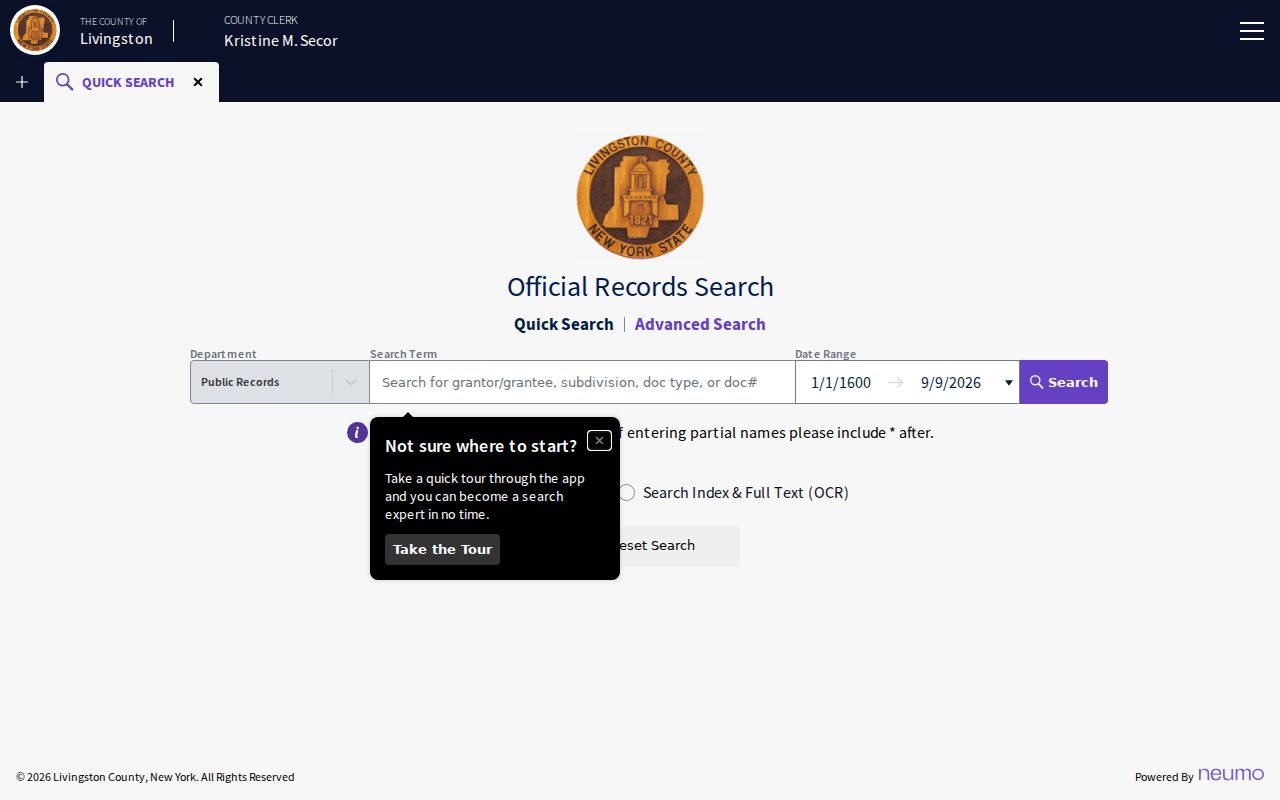
The portal is where deed records and related filings surface in Livingston County. Any hit still needs checking against the parcel number and the legal description before it counts.
Grantor, Grantee, and Document-Term Searching
The grantor conveys the interest and the grantee takes it. Hunting a current deed means searching the likely grantee. To walk the chain backward, find where that party acquired the tract. Then run the prior grantor's name as grantee in the next step. Try surname variants, full given names, and exact entity names. Also try trust or estate phrasing inside a tight date window. OCR reads inside many images. But faint scans, old type, handwriting, and shifting spellings can still hide a valid deed record from view.
- Grantor
- The party conveying the recorded interest.
- Grantee
- The party receiving that interest.
- Chain of title
- The linked sequence of recorded transfers for the same land.
- Book and page
- A recorded-volume citation that can bridge parcel and Clerk systems.
Walk a Livingston Deed Chain Backward
Open with the newest deed that matches the SBL and legal description. Write down the date and document number. Record the book and page too. Note the deed type, grantor, grantee, and property description. Then locate that grantor's own acquisition. Confirm it covers the same tract. Repeat the loop. A shared surname proves nothing by itself. Acreage shifts, reservations, and easements can separate two transfers. Boundary calls and a subdivision lot number can also separate similarly named people. Quitclaim and warranty wording names the form of conveyance, not a grade of quality. An executor's deed, trustee's deed, or tax deed may signal probate inside the chain. A court-ordered transfer may signal litigation there instead. WebSurrogate offers estate leads, while WebCivil Supreme and NYSCEF can surface the related cases.
The Livingston Online-Year Gap and 1821 Boundary
County guidance places land-record custody from 1821 forward. Yet the portal publishes no earliest index year and no image cutover date. Treat the full 1821-present span as unsearchable images until proven otherwise. Copy the citation you have and test the search yourself. Then ask the Clerk for an older book, microfilm, or copy once the index runs dry. Livingston County formed in 1821 from Ontario and Genesee territory. Where older ownership sits depends on each town's parent county. Ossian adds a twist, since Allegany County lost it to annexation in 1857. FamilySearch holds local land images to about 1906 per the County Historian. That collection sets no Cloud Search cutoff.
Read Book, Page, and Legal Description Together
The Hosted Parcel View can show Deed Book and Deed Page. It also lists the owner, SBL, situs, mailing address, and assessment fields. Treat that citation as a bridge, not proof the map label is current. Inside the instrument, compare municipality, parcel calls, and acreage. Check the lot or map reference, adjoining owners, and reservations too. Older deeds often omit modern street addresses entirely. A legal description may run metes and bounds. It may cite a recorded subdivision lot, or lean on a farm, road, creek, bridge, mill, or neighboring owner. Historic maps and newspapers help decode those clues. The deed description still controls. A GIS outline never substitutes for the description or a survey.
Copies, Searches, and Certified Livingston Deeds
The County Clerk fee schedule governs charges for recording, searches, copies, certification, maps, liens, mortgages, deeds, UCC filings, and transfer work. Fees vary by service and document. So check the schedule before mailing payment or placing an order. A plain copy suits research. A certified copy bears the Clerk's certification and may be required for formal purposes. Send party names and an approximate date. Include document type, book and page or document number, and the property description. A focused request lets staff locate the record without turning them into title examiners. FOIL can reach other existing county records, but it never replaces the Clerk's certified-copy process.
Livingston Property Alerts for New Filings
Livingston County announced free property alerts on June 12, 2026. Through the same Cloud Search system, a user can track a name, business, search term, specific document, or several properties at once. The service can also watch property tied to a parent or neighbor. Lawful use and good judgment apply.
Alert limit. Notification can provide early awareness of a filing, but it does not block fraud, insure title, or replace review of Livingston County deed records.
Set alert terms broad enough to catch a filing yet narrow enough to skip the noise. Check any hit against the SBL, the legal description, and the actual image or a Clerk copy.
Maps, Probate, and Liens Complete the Deed Story
A deed chain rarely breaks without a reason. Estates, foreclosures, subdivisions, tax proceedings, and name changes all interrupt the run of recorded deeds. WebSurrogate covers a decedent and the estate's file history. The Supreme Court indexes surface litigation touching title. Clerk categories add lis pendens, judgments, satisfactions, and maps. Mortgage releases need their own look. The original mortgage entry says nothing about its later status.
Old newspapers fill gaps that the recorded instruments leave open. The Historian has rescanned more than 291,000 pages. An ARPA project uploaded material from 1817 through 2013. A notice may point to an estate sale or a tax sale. It may also point to a planning hearing or an old business name. Treat each one as a lead. Return to the recorded instrument to confirm it.
What Livingston County Deed Records Do Not Establish Alone
A deed proves one recorded conveyance and nothing more. It cannot confirm an unbroken chain, resolve an unrecorded interest, pin down a boundary on the ground, or show that every lien was released. Remember that index data can carry spelling and OCR errors. Newly filed documents can also land before an assessment update catches up.
Title limit. Use the Clerk index for research and copies, but obtain qualified title and survey help when legal ownership or a boundary must be established.
Confirm anything important with the County Clerk at 6 Court Street, Room 201, Geneseo, or by phone at 585-243-7010 or 585-335-1712.
Use New York FOIL and the Clerk Counter Correctly
FOIL reaches county records that no public index supplies. It does not oblige staff to build a chain-of-title analysis for you. Keep requests narrow: a date range, names, instrument type, SBL, and any known citation. The general five-business-day framework allows access, denial, or acknowledgment. It may also come with an approximate date. For a certified deed, use the Clerk's established copy channel and current fee schedule.
Some records stay closed. Restricted court papers, sealed matters, and files protected by law sit outside ordinary public access. Describe a missing public record precisely. Do not turn the request into a plea for legal advice. The line between the two matters to the Clerk's staff.